Friday, June 10, 2016

Chronicles of a Free Lunch Kid (Part 3)


During high school I experienced a turnaround during my junior year.  I had a teacher that took genuine interest in her students.  She showed concern for us outside her class requirements and got excited for new opportunities for her students.  I had her for two classes a day and it was the best two classes of the day.  Now I will admit they were woodworking and art but they were a place for me to grow personally.  I had a chance to grow because I was taught to set goals, work to achieve them and then take pride in my work.  This was a great setting for a free lunch kid to not have to think about what I was experiencing but on what my possibilities were.  I began being confident and started to work to earn money but I also continued those qualities that allowed work to be an escape.  I began to feel like one of those kids that paid for their lunch.  I would like to thank Kathy Morgan for being a spark for me.

Dr. Ruby Payne is the education expert on teaching children of poverty.  When I was teaching at Mt. Vernon Township High School, her training was mandated to us as a school improvement activity.  Remember, free lunch kids can be a measure of how a school is performing.  The training was completed to satisfy a goal.  This training was much more to me.  I finally was able to connect my childhood to my new profession.  This was literally an eye opening experience that shaped the way I would approach teaching and schools because I finally understood myself.

In A Framework for Understanding Poverty, Dr. Payne teaches educators the nature of poverty and the hidden rules that middle class educators should know about their free lunch kids.  So much of this is true from my first hand experience.  I began to compare the hidden rules among classes and truly understood why Mrs. Morgan had such an impact on me.  Take a look at this chart from her book:
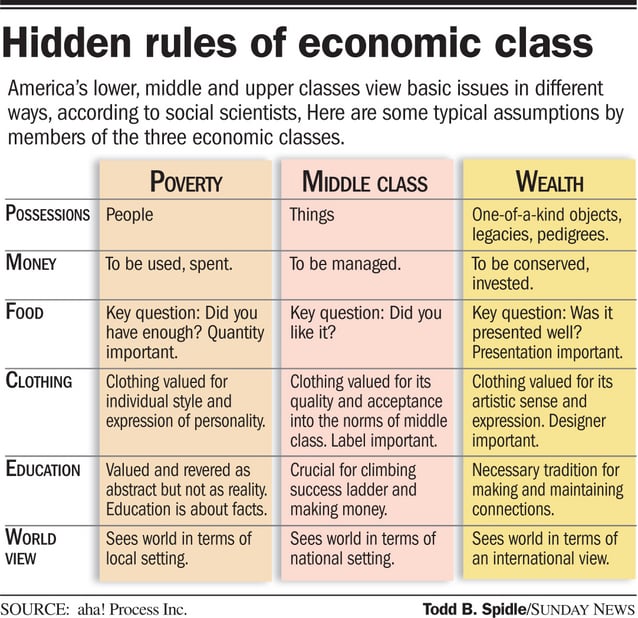

Teachers typically come from middle class backgrounds and this small sample of the hidden rules is a lot to consider in their everyday teaching practice.  Her book provides ways for teachers to create teaching methods activities that reach the free lunch kid.  Mrs. Morgan had no idea she was a pioneer 25 years ago but she did understand and practice the most impactful element of Dr. Payne's book, creating relationships. 

Dr. Payne teaches that relationships are made by making emotional deposits to students, emotional withdrawals are avoided and students are respected.  An example of a deposit would be "Respect for the demands and priorities of a relationship."  I interpret that as not blowing off what is important to a student's social situation or problem.  I listen first and help them apply middle class rules to their dilemma.  This works.  I gain student trust and even when we disagree, they continue to see me as an ally and not the principal.  Sure there is payoff in the form of better work situations for me, but the real payoff is that the relationship is made and maintained.  

Though I am not a paid spokesperson, I encourage any teacher, coach, mentor, social worker and others to familiarize yourself with Dr. Payne's work.  Even if you didn't grow up a free lunch kid it will have an impact on you.  Developing real relationships with free lunch kids makes the difference and could change a life.  It did for me.

I saw Mrs. Morgan in Walmart many years ago.  She was excited to hear that I was a teacher.  I love running into my old teachers, especially since I became a building principal.  I didn't have any bad teachers or any mean teachers but I do selfishly love for them to see what I have done.  Maybe its a small lesson for them that being a free lunch kid was only the surface and my real potential was waiting to be unlocked.

In part 4 I will examine how my adult life has changed my approach to parenting and just whether or not my poverty past rears its head.  How does my childhood compare to theirs?

Wednesday, June 8, 2016

Chronicles of a Free Lunch Kid (Part 2)

I took the long drive to the new and wonderful Marion High School to seek out my student records.  I was able to only obtain my high school record but that's okay.  There is enough to be said about that data and even more to be said about what is behind that data.  Lets take a look at the common academic setbacks for free lunch kids according to the research.

Lower School Attendance

I missed 49 days over the course of my four years in high school.  That's not great and it's not horrible.  Most notable about that is that I missed 28 days during my sophomore year.  Two thoughts on that.  At the start of the school year we suffered a house fire.  Sure there was insurance and the house was restored but families of generational poverty to do not have the support system or the minimal financial obligation for the initial disaster.  With a disabled grandmother as a care giver my brother and I had to move us to a rental and get settled.  We had to be the men of the house and school was not a priority, surviving was.

Another note on attendance.  At 28 days in 2016, I could have been referred for truancy services.  This might entail meetings and a possible visit with the State's Attorney.  This is another at-risk label thrown upon many free lunch kids.  There are many data points that can put a kid into a system of some kind.  

Grade Failure and Dropping Out of High School

I failed a semester of Geometry my junior year.  It was not required to take so I easily slid into an early bird class and stayed on track.  I did manage to earn seven D's during my freshman and sophomore year.  The transition from junior high to high school is tough for most kids and is a significant factor in high school dropout rates.  Most of these low grades came in Math and English which are core academic areas.  Research does support this as a characteristic of a free lunch kid.  In fact I scored a 18 in English and a 19 in Math on the ACT.  Those scores are not horrible but being in the middle of the road does not usually trigger the notion that I should be in some kind of support program.  There is a reason that I rebounded well in my junior and senior years and stayed on course to graduate.  I will save that for part 3.

Behavior Problems

I never had any behavior problems or exhibit risky behaviors.  I never got swats in school because I knew what would be waiting for me when I got home.  We didn't have much but I was brought up right.  Emotional problems are another story.  The stigma you carry when you walk up to the lunch lady and have to verbalize that you are a free lunch kid is devastating.  I remember in grade school they gave us a small sheet of lunch tickets each week and we had to tear them off when we got our tray.  Most kids were paying with money and I had a little white slip.  It was easy to tell early on that you were different.  

That stigma becomes greater in junior high and high school.  The haves and have not are more noticeable and defined.  For free lunch kids this sets off a huge lack of self worth and confidence issues.  It was tough for me to really find my place socially.  I had friends and the occasional girlfriend but surprise surprise, my first couple of girlfriends were from a different town that I had met at the skating rink.  They were not from my school and did not know my standing there.  It was easy not to connect with my peers early on because I felt disenfranchised.  

In a lot of ways my youth did fit what research tells us about free lunch kids.  The summer between my sophomore and junior year would be pivotal.  The real way to reach a free lunch kid was revealed to me and I still work to reach all my free lunch kids the same way.  Maybe its not a secret to some but I know what worked for me.  In Part 3 I will offer my turn around story.

Saturday, June 4, 2016

Chronicles of a Free Lunch Kid (Part 1)

It's taken me a while to write on this topic despite my connection to it.  My hopes are that school leaders and teachers will change their perspective when it comes to the low income children they serve.  The ultimate hope is that a free lunch kid like me will hear the message.

If you are employed as a school teacher or administrator you know that low income students have been a part of school improvement conversations.  In the No Child Left Behind era it was a subgroup that you had to plan for and plan around for raising standardized test scores and for some, they are an excuse for poor standardized test scores.  Either way there is no doubt that poor kids are part of the conversation for schools.  In short, your free lunch kids can determine achievement for your school especially in areas where low income percentages are high.

Schools now have a national standard to reach in terms of standardized test achievement.  Schools work hard to bridge the gap between low income kids and middle class kids when it comes to learning.  Whole bodies of research have been developed on reaching the low achieving poor kids in schools.  After all, if we help them score better than the school building's scores go up and we save ourselves from sanctions.  The effort and training sounds like it is worth the payoff.  I'm 40 years old and I went to school in the late '80s and early '90s.  I was a free lunch kid.  I don't ever recall being reached out to and definitely didn't feel important to my school's performance but that was a different time.

I was raised by my grandmother since I was a year and half old.  Her last husband died when I was ten leaving us with just social security and disability income for five family members.  When I was ten the federal poverty line for a house of five was $13,259.  Her income was approximately $10,000.  To make up the difference we got other forms of government assistance including food stamps, a medical card and Reagan Cheese.  This is how free lunch kids are identified in school.  You live below the poverty line and/or receive government assistance.  Today that line is at $28,440.  If a kid lives in a house of five at that income level they can be one of the 31 million that are served by the national free lunch program.  This line of funding is the largest from the federal government to local school districts totaling $16 billion.

Now that we have those numbers straight, each of those kids is now part of a metric.  This percentage will determine the effort made by your school district to raise test scores.  This include training, changing teaching methods and establishing programs for the disadvantaged.  If they can improve you and other members of subgroups, like those receiving special education services, then they can enjoy prosperity in the world of school accountability.

To avoid sounding cynical and to be fair, giving this kind of attention to free lunch kids is not a bad thing.  Under NCLB, the number of children living below the poverty line was rising.  It makes good sense to address children in poverty at the same time you are emphasizing higher test scores.  My struggle with this attention is that we free lunch kids are being treated like policy and not like people.  My experience as a free lunch kid has compelled me to write about it.  In my next post I will dig into my school records to see if I fit the description of a kid that the poverty research tells us about.  Researchers tell us that poor kids suffer from lower cognitive and academic development, higher grade failure, lower attendance and are more likely to drop out.  it's time to see if the shoe fits.  Stay tuned for the next post.

Saturday, May 28, 2016

A Fist Full of Certificates

One phenomenon I love during this time of year is how much parents post about their kid's school awards.  Really, I do actually like it.  Seeing a picture of a smiling kid with a fist full of certificates is not at all offensive to me.  Now on the other hand, showing your kid's participation ribbon from field day is a little offensive to me.  There is a distinct difference in good and bad praise for kids.  I am no child psychologist but I am a practicing educator that has seen it all.

Long term goal setting is a much needed skill.  The problem seems to be that too many parents are convinced that awards should be handed out for everything.  To that I say, "slow down."  What you praise with your child is the value set you are teaching them in a covert way.  You don't see it but the praise you give for that little prize they won from a drawing is not actually helpful.  There are all kinds of awards and prizes given out for just being there.  They are claimed to boost a child's self esteem.  The only true way to build self esteem in a child is to help them set a goal and then work through the ups and downs until they reach it.  Having high self esteem does not mean feeling good.

Tell me if this sounds like anyone you know.  A parent posts every small victory (that should just be a step towards a long term goal) but when their child hits an obstacle it suddenly becomes the school's fault.  I get to hear a lot of these comments from parents that are interested in making their kids happy and not trying to develop them:

  • He better make the team.  He has put in his time. (quality vs quantity argument)
  • That teacher just doesn't like him.
  • He tried his best, why cant you just pass him? (trying is not setting a high standard)
  • He says there's a boy in his class that does this all the time and never gets in trouble.
  • I can't make him do it. (my favorite)

Instead, they should work with their kid to replicate those victories and learn from their loses.  Let's face it, blaming others for lessons your kid should be learning is how we create cry babies and brats.  You know it's true.

As a parent I try to communicate to my kids that set backs are lessons and the end result is the true award.  Trophy or not, your kids can still be winners at life.  Parents often cling to the short term accomplishments because they are unwilling to take the long journey with their kids.  Rather, they just want their kids to be happy.  Happiness comes from those little trophies but fulfillment comes from long term goal achievement.  My kids will be adults some day and for a long time.  I would rather prepare them for the roller coaster of adulthood than promise them that their feelings should never be hurt.

I was very proud of my kids this school year.  Despite hiccups along the way, they both were 5.0 students.  Not because I told them they had to be.  It's because they showed a genuine interest in making good grades.  They both almost had perfect attendance which was their own planned goal.  They showed responsibility to those goals and saw them through.  The award certificates are nice but what it does for them inside is much more valuable.  This my friends is what builds self esteem.  They set the goals, they attained them.

So post on parents.  Be proud of your kids when they win year long awards.  Its a great thing to celebrate with them.  But beware praise for things that are smaller parts of a large goal.  Take the journey with them and guide them through it.  Teach them that obstacles are lessons to help achieve goals and not conspiracies to hold them back.  Your kids will be better adjusted adults and please realize that they will be adults far longer than they will be children so what we do now is critical.


Personally, this is how I like the pictures of my kids.  No certificates, just smiles.  I won't lie, if either of them get into Harvard Law School I will post about it every day until Facebook and Twitter ban me from their sites.  Until then, smiles are good.

Sunday, May 22, 2016

Old Dogs New Tricks and Blogging

I was so incredibly excited to read that Elverado won the state bass fishing tournament.  As I looked at the pictures on social media I saw what made me proud to be a part of that school district.  In the background you could see a smiling Dave DeWulf.  Dave is now retired from his teaching job at EHS.  He was our vocational teacher and the bass fishing program started when we were there.  I was happy to sign the paperwork and he made the magic happen.

Dave is the reason that small schools are a joy to work in.  He cared deeply for kids and through his classes, he served our school and community.  He always saw the value in kids even when they didn't see it themselves.  Elverado is full of wonderful people like Dave.  I was a young principal (hired at 30) and he could have easily made my life hell but we respected each other because we valued the same things.  Well most things.  I was techie teacher and now an administrator and when I was hired the rumor was that Dave had never opened his email.  Ever.  We also joked that his use of email should be a performance indicator for me as his Principal.  If I could get him to use his email, I would have proven myself as a Principal.

I always wondered how people, especially in education, disregard the internet as a professional tool.  The most powerful tool technology has yet to give us should be what is empowering teachers.  If you are reading this you get it, but how do we get more of our old dogs to learn these new tricks?  That's not to say that more experienced teachers are not using Twitter, Pintrest and the like because we have great Twitter participation in our district.  But social media has to be more than just posting about projects made in our classrooms.  It needs to be more than just updating the scores.  It needs to be storytelling.

As a former social studies teacher I understand the value of story telling.  When more experienced teachers talk, I listen.  I want to know their perspectives because they have been shaped by history and experiences.  I have learned the most from the old dogs around me (I say that with love).  I have written in this blog for the 91st time with this post but none of what I have experienced at 39 is as interesting as stories told by someone that has been in education for 30 years.  These folks have seen a lot and if we want to find ways to make K-12 education great again, we have to listen to the stories of people that have seen the good, the bad and the ugly.

I would like to challenge our old dogs to teach us NCLB era people through blogging and social media.  We need to listen to your perspectives and allow them to help maintain the integrity of our profession.  On a side note, Dave did start checking his email.  He actually found it quite useful as a tool and I used to love getting called down to his room to help him with it.  I am however, still trying to find him on social media.  Maybe someone over that way can get him there.

Friday, April 1, 2016

The Erosion of School Discipline in Illinois

Be honest, you have been a public place and seen a child misbehaving and thought "that kid needs his butt busted."  At least you have read or seen a news story of kids behaving badly and thought, "what is wrong with these kids today?"  I know you have told your kids stories or reminisced with friends about getting spankings or swatted at school.  All in an effort to tell your kids what it used to be like or to let them know how good they have it.  At any rate I think the discussion has been worn out about discipline and how it should be done.

In Illinois paddling (corporal punishment) was banned in 1993.  We were part of a wave of states doing so after advocacy groups pushed for legislation in several states.  Despite the research support against corporal punishment, 19 states still allow it.  Of those 19, 10 states are southern states and not shockingly enough one is Texas.  That tells me that this is a regional preference.  These parts of the country seem accept that this is part of their culture or they would change it.  To add more hurt to the advocacy groups, there is US Supreme Court precedence on the issue ruling that corporal punishment is not a matter of cruel or unusual punishment nor is it a denial of the student's due process rights.  Regardless of where you stand on the issue, swatting has survived in portions of the country just not in Illinois.

Illinois has recently passed another law restricting student discipline.  SB 100 was born out of an effort from Chicago parents and students called Voices of Youth in Chicago Education (VOYCE).  The group cites data that shows that students of color are suspended at a disproportional rate compared to white students.  The result is a law that places restrictions on the suspensions of students and requires schools to take more steps to correct problematic behavior.  You know, what parents used to do.  I absolutely applaud the effort of people coming together for meaningful change.  It should happen more often.  On the other hand, based on my own administrative experiences, I have to ask is this a state problem or a Chicago problem?  Should this have been a victory for parents and students of Chicago Public Schools instead of statute for an entire state.  This civil rights issue may not be as prevalent in other parts of the state.

Paddling has found a way to live on in a few states based on local preference or culture.  SB100 , what I think should have been a local initiative, is yet another example of change happening to schools instead of schools being the catalyst for their own change.  Out of curiosity I checked the voting record of my local legislators on SB100.  My senator didn't vote on the measure and his two corresponding representatives both voted yes.  Right now administrators are losing their minds and seeing the worse in the law.  Fellow admins, the sky is not falling but the signs of erosion are there.  I wonder if our legislators could see this law as a burden to mandate heavy schools or if it was part of another political game that they could champion later.

The bottom line is that we as professionals in the education field have support when it comes to legislation that might happens to us.  Vision 20/20 is an excellent example of taking back our schools through legislation.  As I wrote before, this is how we take back the schoolhouse.  The Illinois principals Association is great about legislative information but do you scroll past it or take the time to engage with it.  The next time you see an Advocacy in Action email show up, take a look.  Had I done so maybe I could have engaged my two legislators that didn't vote the way I would like them to on SB100.  We are important instruments of our own change in Springfield and as such we can slow down or even stop the erosion of our school's futures.  I'm not saying we can bring back paddling but we can at least prevent what might not be good for kids or schools.

Tuesday, March 29, 2016

Bernie Sanders Dank Meme Stash

I am a firm believer that most of the time my social media feeds are only good for the memes. You know, those pictures with funny captions that you just have to stop and read.   Some of these are pretty clever and out of jealousy I have dabbled in making my own using a an app on my phone.  My newest one below has yet to debut and its really not funny but hey, its a start.


I have recently took a liking to Bernie Sanders Dank Meme Stash on Facebook.  If you are one of the more than 430,000 members of the Facebook group or you have friends that are, you have seen the dank memes come through your timeline.  They can be informative, funny or even insulting but it is born out of the minds of the users and meme creators.  This is the trend for news consumption in the world of social media, quick and easy.

I will fess up and say I am a Bernie supporter but that is not what draws me to these memes.  It is the movement that I'm drawn to.  What a fascinating unintended campaign positive.  Your supporters rise up on social media and share your message for you and its free.  Bernie has locked in the millennial vote despite being 74 years old and no signs of any "product" in his hair.  This is how millennials and soon to be people of any generation get their information, though quick spurts of funny and informative pictures.  It is hard to pass up information consumption like that as fast as information is moving.  It suits people and they do get the message even if they are not very political savvy.

Along those lines is the dark side of the meme.  When people that are not very politically savvy or not even politically knowledgeable begin making memes they tend to use profanity or they are riddled with falsehoods.  Or they use a context that not all people are familiar with such as one of my favorites below.  If you have not seen the Dark Knight movies you might fail to appreciate it and you might dismiss it.  The really bad ones can hurt the candidate because it always appears to come from you when your face is on the meme.  But what can a candidate do about this when they have no control over content that is user created?   


This is the internet as we have come to know it.  We like the quick information, especially when it supports our position, but we hate having to put up with those that may not support us or they are misguided in their support.  But this is America, Jack and we have freedom of speech even if it offends others.  The Bernie Sanders Dank Meme Stash is a great world to get into even if you do not support Bernie.  It will give you a taste of what a social media movement is all about.

You can find BSDMS on Facebook or on Twitter at @BernieSDnkMStsh

The 10:1 Rule Remastered

I used to do speaking engagements and professional development on serving low-income students.  One of the ways I encouraged my attendees to...